

| The Padma Barrage: Beyond a Dam — Bangladesh’s Strategic Architecture for Water Security, Smart Delta Governance, and National Development A technical-governance assessment and strategic policy framework for the Padma Barrage Project |
| Engineer Johnny Shahinur Alam | Policy Innovator · Digital Governance, Digital Transformation & AI Expert |

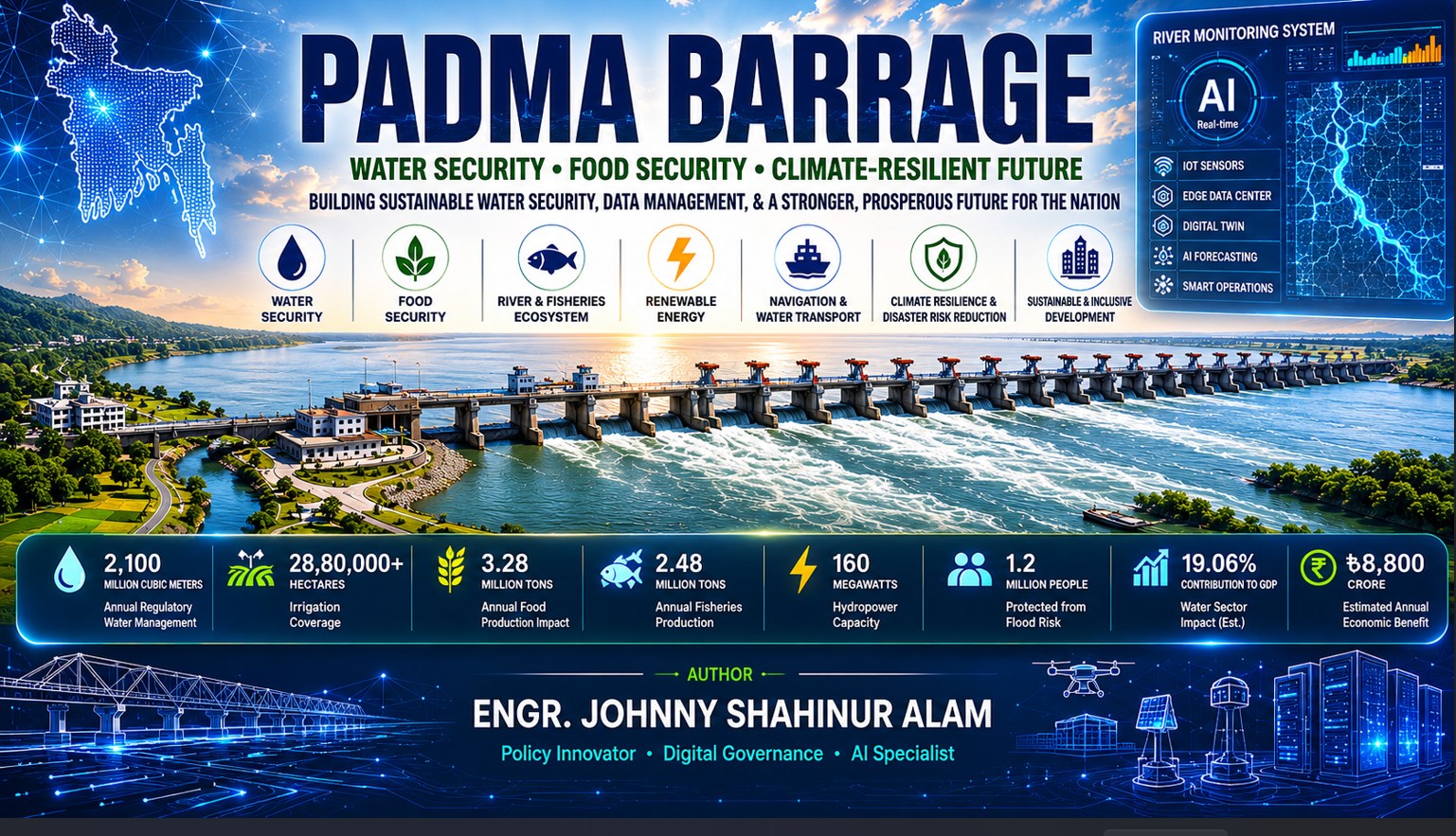
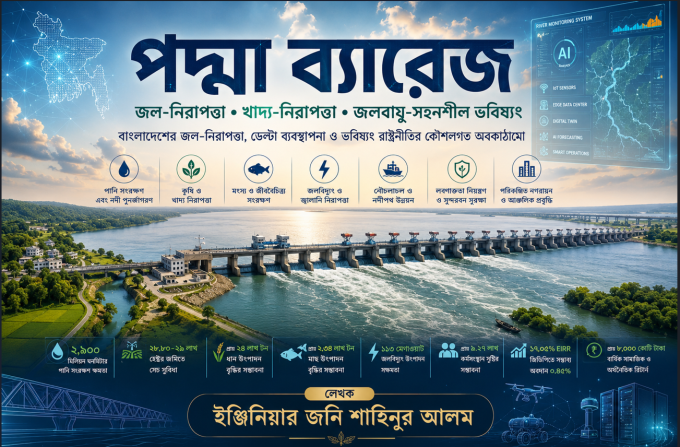
| EXECUTIVE SUMMARY The Padma Barrage Project represents one of Bangladesh’s most far-reaching infrastructure undertakings in decades. Approved on 13 May 2026, Phase I carries an estimated cost of BDT 33,474–34,497 crore, with an aggregate project cost of approximately BDT 50,443 crore. To be constructed across the Padma river at Pangsha in Rajbari, the approximately 2.1-kilometre barrage will incorporate 78 spillways, 18 under-sluices, two fish passes, and navigational facilities. This project is not merely a barrage. It represents four converging strategic systems: a Water Security Infrastructure, a Climate Adaptation Platform, an Integrated River Basin Management System, and a Smart Delta Governance Model — each with distinct design, operational, and institutional demands. |
| 2.9B m³ WATER STORAGE CAPACITY | 113 MW HYDROPOWER OUTPUT | 2.8–2.9M ha IRRIGATION COVERAGE | 2.4M t ADDITIONAL RICE YIELD |
| 234,000 t INCREASED FISH OUTPUT | 927,000 JOBS CREATED | 0.45% ESTIMATED GDP CONTRIBUTION | 17.05% EIRR |
01 Technical Architecture: A Multi-Purpose River Management System
A modern river barrage is considerably more than a water-retention structure. It is an integrated system for flow regulation, irrigation distribution, inland navigation, sediment management, ecological fish passage, hydropower generation, salinity control, and environmental flow assurance. Each of these functions places distinct — and at times competing — demands on design, operation, and institutional governance.
The Padma Barrage’s structural configuration — comprising 78 spillways and 18 under-sluices in addition to fish passes and navigation locks — offers significant operational flexibility. This flexibility, however, must be actively and intelligently exercised. A barrage that defaults to static water retention, irrespective of seasonal variation in sediment load, flow regime, and ecological requirements, will progressively underperform and impose avoidable environmental costs.
| For the Padma Barrage to fulfil its potential, it must be conceived and operated not as a reservoir, but as a regulated, data-driven, sediment-intelligent river system. |
This distinction — between a dam and a governed river management platform — is the central operational and policy challenge the project must resolve from the design stage onward.
§ 02 Water Security and Agricultural Transformation
Bangladesh is a riparian nation that nonetheless lacks water security. The paradox of seasonal flood abundance alongside dry-season scarcity — exacerbated by upstream flow variability — afflicts agriculture, fisheries, drinking water supply, inland navigation, and environmental health simultaneously.
The Padma Barrage offers a structural pathway from reactive crisis management to strategic water governance through three mechanisms:
| THREE PILLARS OF STRATEGIC WATER GOVERNANCE |
| Seasonal storage and re-distribution: Conservation of dry-season flows with deliberate augmentation of the Gorai-Madhumati system and connected distributary rivers. |
| Groundwater dependency reduction: Surface water availability at scale can reduce the structural over-extraction of aquifers that currently sustains dry-season irrigation. |
| River revival economy: Sustained flows revitalise fisheries, navigation, and riparian livelihoods as productive economic sectors rather than declining ones. |
When reliable water supply is secured, the agricultural potential of south-western Bangladesh transforms materially. Mono-crop rice cultivation can give way to multi-seasonal farming, high-value cash crops, and export-oriented agricultural production. Integrated with cold chain logistics, digital market platforms, and rural agro-processing investment, the region has the structural conditions to develop into an Agro-Industrial Growth Corridor — but this outcome requires deliberate policy rather than organic emergence.
03 Sediment Management: The Critical Governance Challenge
3.1 The Ganges-Padma Sediment Reality
The long-term performance of the Padma Barrage will be determined, more than any other single factor, by the quality of its sediment management. The Ganges-Brahmaputra-Padma system is among the world’s most sediment-intensive river systems. The Padma can carry flows of 30,000 to 75,000 cubic metres per second during the monsoon season, transporting enormous quantities of suspended sediment.
| RISK: CONSEQUENCES OF INADEQUATE SEDIMENT MANAGEMENT |
| Rapid reservoir infilling and progressive loss of effective storage capacity |
| Riverbed aggradation, char formation, and deteriorating navigability |
| Increased drainage congestion and local waterlogging |
| Downstream sediment starvation — critically reduced sediment supply to the Sundarbans-estuary system |
| Disruption of the river’s morphological equilibrium |
3.2 A Sediment-Smart Barrage Operation Plan
International evidence — including World Bank research on reservoir sedimentation — is unambiguous: sediment management is not a maintenance afterthought. It must occupy the centre of design, financing, operations, and governance from day one. The Padma Barrage requires a mandatory Sediment-Smart Barrage Operation Plan encompassing the following elements:
| MANDATORY COMPONENTS — SEDIMENT OPERATION PLAN |
| Real-time sediment monitoring: ADCP surveys, drone-based bathymetry, satellite imagery, turbidity sensors, suspended sediment concentration measurement, and riverbed-level tracking. |
| Seasonal sediment profiling: Distinct sediment maps for monsoon, post-monsoon, and dry-season conditions. |
| Gate-specific flushing protocols: Seasonal operational rules for each of the 78 spillways and 18 under-sluices. |
| Predictive dredging plans: Grounded in sediment budgets, navigation requirements, ecological flow, and bank stability analysis. |
| Annual Padma Sediment Account: Public reporting of upstream deposition, downstream sediment deficit, navigation depth, dredging volume, erosion hotspots, and ecological impact indicators. |
Project success metrics must be redefined accordingly. Stored water volume alone is an insufficient performance indicator. Reservoir lifespan, sediment routing efficiency, downstream river health, maintained navigation depth, and ecological flow compliance must all be formalised as key performance indicators alongside hydrological outputs.
04 Smart Barrage Governance: AI, IoT, and Digital Infrastructure
4.1 The Digital River Twin
A twenty-first century river barrage is not solely concrete-and-gate infrastructure. It is simultaneously a data infrastructure, an AI governance system, and a climate intelligence platform. The highest-priority technical recommendation for the Padma Barrage is the construction of a Digital River Twin — a real-time virtual model of the Padma river and barrage system — integrating water flow, sediment load, gate operation status, river depth, salinity intrusion, floodplain inundation, erosion hotspots, fish migration patterns, rainfall dynamics, and groundwater interaction within a single analytical environment.
4.2 Technology Layer Architecture
| AI SEDIMENT INTELLIGENCE Satellite imagery, sonar survey, ADCP flowmetering, turbidity sensors, and historical hydrological data synthesised to forecast deposition hotspots and morphological shifts. | RIVER IOT SENSOR NETWORK Multi-point monitoring: water level, sediment concentration, salinity, dissolved oxygen, current velocity, groundwater, and fish movement sensors deployed across the basin. |
| EDGE DATA ARCHITECTURE Local edge data clusters at the barrage and downstream nodes providing low-latency AI processing for flood warning, emergency discharge, flushing protocol, and navigation control. | AUTONOMOUS INSPECTION SYSTEMS Underwater inspection robots for gate foundation integrity, scour depth, and structural health scanning; drone-based river surveys; and autonomous dredging systems. |
| SMART IRRIGATION & AGRO-IOT Soil moisture sensors, satellite crop monitoring, AI-driven irrigation recommendations, automated canal gates, and mobile farmer dashboards connected to the barrage data platform. | FLOOD & SALINITY EARLY WARNING Flash flood warning systems, riverbank erosion prediction, salinity intrusion forecasting, drought risk analysis, and irrigation stress mapping for downstream communities. |
4.3 Proposed Institutional Structure
The digital governance framework outlined above requires dedicated, specialised institutions with clear mandates, technical capacity, and operational independence. The following bodies are recommended:
| PROPOSED SPECIALISED INSTITUTIONS |
| Padma River Data Authority — real-time data collection, archival, and open-access publication. |
| River AI Research Laboratory — analytical centre for sediment, flood, salinity, and fisheries pattern modelling. |
| Independent Sediment Audit Board — verification and public reporting of the annual Padma Sediment Account. |
| Climate Risk Monitoring Centre — long-term observation of river system change in the context of climate variability. |
| Digital Fisheries Platform — fish migration tracking, production monitoring, and data connectivity for fishing communities. |
05 Environment, Biodiversity, and the Sundarbans
The ecological dimensions of the Padma Barrage are not peripheral to its mission — they are integral to its long-term legitimacy and economic viability. The two fish passes specified in the project design must be engineered to the highest functional standard and subject to rigorous, independent performance auditing. Seasonal fish migration — particularly for hilsa, rohu, catla, and floodplain-dependent species — requires species-specific hydraulic design informed by fisheries science, not structural convenience.
| The escalating salinity of south-western Bangladesh constitutes a climate security crisis. Sustained freshwater flow in the dry season is among the most cost-effective interventions available to protect the Sundarbans ecosystem, agricultural productivity, and coastal livelihoods. |
A Sundarbans Salinity Observatory — a permanent monitoring station providing continuous salinity, flow, and ecosystem health data across the Sundarbans-estuarine transition zone — should be established as a non-negotiable component of the project’s environmental governance architecture. The data generated will be critical for barrage operational decisions, diplomatic negotiations, and long-term delta management.
Environmental flow obligations must be legally defined and operationally enforced. A minimum ecological flow regime — calibrated to seasonal variation and species requirements — should be enshrined in the barrage’s operational mandate, not treated as a discretionary adjustment.
06 Economic Impact and Regional Development
Project assessments cite an estimated annual socioeconomic return of BDT 8,000 crore, an EIRR of 17.05 per cent, and a potential GDP contribution of 0.45 per cent. During construction, approximately 122.5 million person-days of employment are projected, engaging around 47,950 workers, with direct and indirect employment reaching approximately 927,000 persons. These are significant figures, but their realisation is conditional.
The Padma Barrage should be analysed as a Regional Growth Multiplier operating through five distinct economic strata:
| FIVE ECONOMIC IMPACT STRATA |
| Agricultural income: Irrigation security unlocks crop diversification, high-value cultivation, and multi-seasonal farming cycles beyond rice mono-cropping. |
| Fisheries and aquatic economy: Year-round water presence in rivers, canals, and floodplains — contingent on ecological flow and fish passage performance — can substantially increase fisheries output. |
| Inland waterways and logistics: World Bank data indicates Bangladesh’s inland waterways carry approximately 194 million tonnes of cargo annually. Dry-season navigability contracts from 6,000 km to 3,900 km. Improved dry-season navigability reduces transport costs and expands regional trade. |
| Agro-processing and SME economy: Production stability attracts food processing, cold storage, packaging, rural warehousing, dairy, fisheries processing, and export logistics investment. |
| Climate loss mitigation: Reducing salinity damage, drought impact, water shortage, and crop failure is economically equivalent to a direct income transfer to affected communities. |
The multiplier effect will operate through production, market, and investment channels. However, multiplier effects are not automatic. Realising them requires deliberate policy instruments: agricultural zoning, river-port planning, cold-chain finance, SME credit provision, land-use regulation, floodplain protection, local skills development, women-led enterprise support, climate insurance, and digital market platforms. Infrastructure creates the conditions; policy delivers the outcomes.
07 Planned Urbanisation and the Digital Industrial Corridor
The project concept encompasses seven satellite townships and housing provision for approximately 150,000 families. Large infrastructure projects frequently catalyse uncontrolled urbanisation, land capture, environmental degradation, and social stratification. This risk must be directly addressed in urban planning mandates.
The satellite towns must be conceived not as housing settlements but as climate-resilient urban planning models — each incorporating safe water supply, modern waste management, urban forestry, rainwater harvesting, waterlogging management, public transit, local employment generation, health services, education infrastructure, digital service connectivity, and renewable energy integration.
If edge data centres, fibre connectivity, and smart logistics corridors are integrated into the project’s scope, south-western Bangladesh acquires the preconditions for an agro-tech startup ecosystem, a river logistics platform, climate data analytics industries, smart fisheries management, AI-enabled supply chains, and rural e-commerce infrastructure. When combined with the Padma Bridge, rail corridor, inland waterways, and digital infrastructure, the region has the structural assets to constitute a Digital Agro-Industrial Corridor of national significance.
08 Water Diplomacy and Transboundary Cooperation
The Ganges-Padma is a transboundary river system, and dry-season flow uncertainty constitutes a persistent strategic vulnerability for Bangladesh. The Padma Barrage will materially enhance Bangladesh’s domestic water storage capacity, thereby reducing dependence on upstream release decisions and strengthening Bangladesh’s position in future water negotiations.
However, the diplomatic strategy pursued should not be adversarial. The appropriate framework is basin cooperation — joint hydrological modelling, sediment data sharing, coordinated environmental flow management, and engagement within the structures of regional water governance. A cooperative approach grounded in shared data and mutual interest is more likely to produce durable agreements than positional bargaining.
Bangladesh’s investment in digital river monitoring and sediment intelligence creates a significant opportunity: high-quality domestic data can serve as both a negotiating asset and a contribution to regional basin knowledge, elevating Bangladesh’s standing as a technically credible partner in transboundary water governance.
09 Policy Recommendations
Seven policy measures are essential for the Padma Barrage to deliver its projected benefits and avoid the failure modes observed in comparable projects internationally:
| 1 | Establish the Padma Basin Authority Create an independent, operationally effective authority with integrated mandate covering water, sediment, agriculture, fisheries, environment, navigation, and urban development across the basin. Fragmented sectoral management is the single greatest governance risk to this project. |
| 2 | Mandate a Digital River Twin and AI Forecasting System Technology integration must be specified from the design stage, not retrofitted during operations. The Digital River Twin and its associated AI analytical systems should be contractual requirements, not aspirational additions. |
| 3 | Legally define Environmental Flow obligations Establish a minimum ecological flow regime in statute, calibrated to seasonal variation and species-specific requirements. Discretionary environmental flow management has a poor international track record. |
| 4 | Institute a Sediment Management Framework and Annual Padma Sediment Account Sediment governance must be formalised as a statutory obligation with annual public reporting, independent audit, and consequences for non-compliance. |
| 5 | Require regular Fish Passage Performance Audits The functionality of the two fish passes must be independently verified on a scheduled basis, with findings reported publicly and operational adjustments made accordingly. |
| 6 | Establish a Sundarbans Salinity Observatory A permanent monitoring station for continuous salinity, flow, and ecosystem health data across the Sundarbans transition zone is essential for operational decision-making, environmental compliance, and diplomatic purposes. |
| 7 | Implement a Benefit Realisation Framework Annual public reporting of: irrigated area, farmer income, fish production, inland cargo volumes, new SME formation, employment created, and measurable benefits accruing to women and marginalised communities. Outputs without outcomes are insufficient justification for public investment of this scale. |
| Conclusion: From Barrage to Smart Delta State The Padma Barrage represents a genuinely historic opportunity for Bangladesh. If designed, governed, and operated to the standard the evidence demands, it will accomplish far more than water storage. It will establish a new development compact — linking water, food, energy, the environment, river economics, digital technology, and climate adaptation into a coherent national system. International experience is clear on what differentiates transformative infrastructure from infrastructure that merely exists: the quality of data governance, the rigour of sediment and ecological management, the independence of institutional oversight, and the political will to measure and publish outcomes rather than outputs. If the Padma Barrage is built to these standards, it will not only serve Bangladesh — it will establish a policy benchmark for delta states globally at a moment when such models are urgently needed. The central question before Bangladesh’s policymakers is this: will the nation seek to control its river, or will it build the wisdom and governance capacity to coexist with it — learning its rhythms, its sediment, its ecology — and design a development philosophy accordingly? The answer will determine whether the Padma Barrage is a structure that lasts, or merely one that was built. |




Leave a comment