
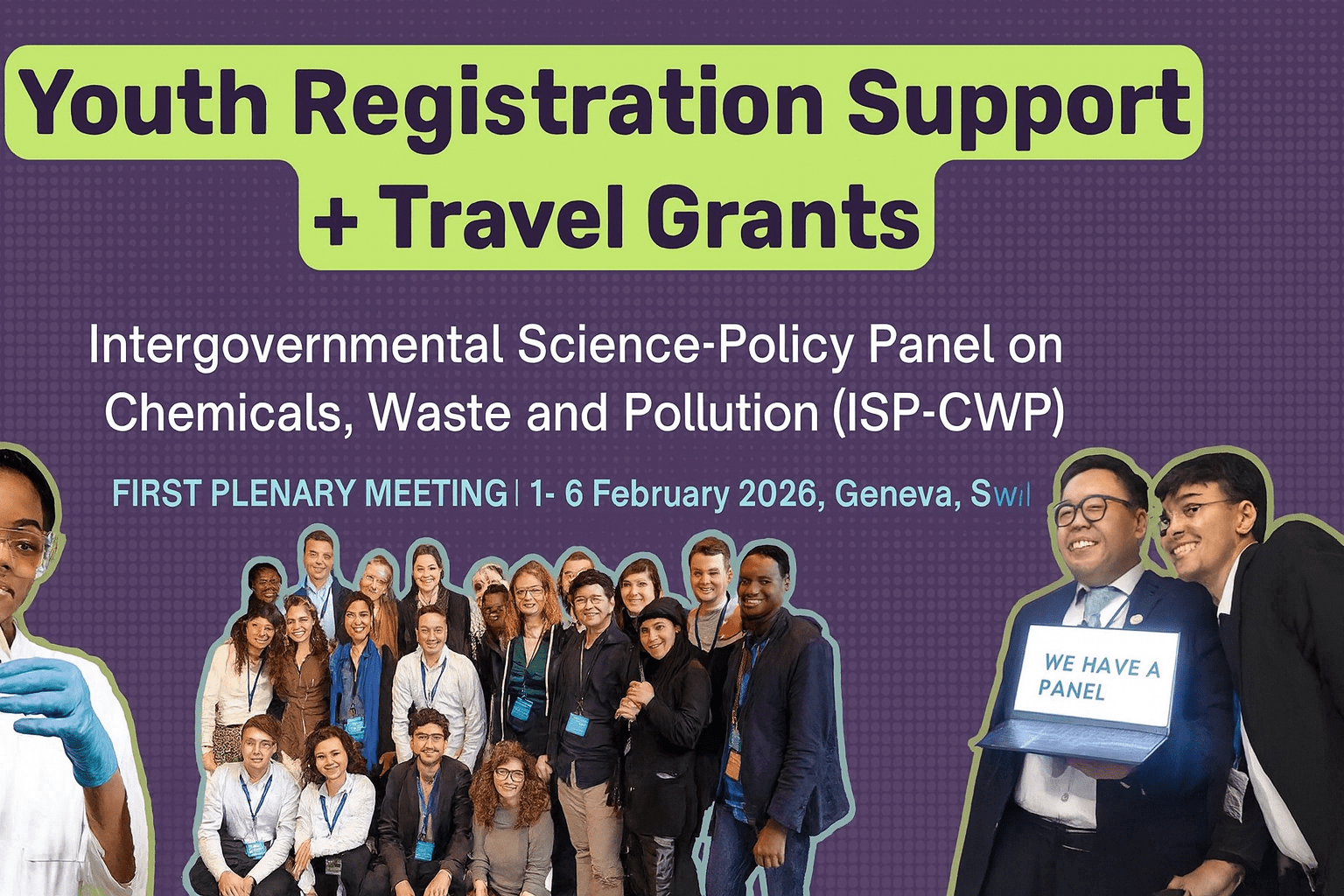
Are you 35 or under and passionate about chemicals, waste, pollution and environmental justice? You can now apply to join the First Plenary of the Intergovernmental Science-Policy Panel on Chemicals, Waste and Pollution (ISP-CWP P1) in Geneva, Switzerland — with travel funding support available for selected youth.
This open call is coordinated by the Chemicals and Waste Youth Platform (CWYP) and the Youth Science-Policy Interface (SPI) Platform to ensure that young people are directly involved in shaping this historic new UN science-policy body.
Quick Overview
-
Event: First Plenary of the Intergovernmental Science-Policy Panel on Chemicals, Waste and Pollution (ISP-CWP P1)
-
Dates: 1–6 February 2026
-
Location: Geneva International Conference Centre (CICG), Geneva, Switzerland
-
Who can apply: Youth aged 35 or younger (individuals and youth organisation representatives)
-
Support available:
-
Application deadline:
Because deadlines are set by UNEP / the ISP-CWP Secretariat, this opportunity has a very short turnaround. If you’re interested, you should apply as soon as possible.
Why This Plenary Matters – and Why Youth Must Be There
At the fifth UN Environment Assembly (UNEA), governments agreed to create a new independent, intergovernmental Science-Policy Panel to support the sound management of chemicals and waste and the prevention of pollution. Modeled on bodies like the IPCC (for climate) and IPBES (for biodiversity), this panel fills a critical gap in tackling the “third planetary crisis” – pollution. UNEP – UN Environment Programme+1
In June 2025, countries formally agreed to establish the Intergovernmental Science-Policy Panel on Chemicals, Waste and Pollution (ISP-CWP). UNEP – UN Environment Programme+1
The Panel will:
-
Scan for emerging risks from chemicals, waste and pollution
-
Conduct large-scale scientific assessments and identify science-based solutions UNEP – UN Environment Programme
-
Support information sharing across disciplines and knowledge systems
-
Help strengthen capacity in developing countries, including data and monitoring systems genevaenvironmentnetwork.org
However, key questions are still undecided and will be taken up at this first plenary, including:
-
Final wording of foundational documents (scope, objectives, functions, operating principles)
-
Financial procedures and budget
-
How ISP-CWP will collaborate with existing instruments (WHO, Global Framework on Chemicals, Basel–Rotterdam–Stockholm Conventions, Minamata Convention, etc.)
-
Rules of procedure and observer participation
-
How the work programme and deliverables are decided
-
The Panel’s conflict of interest policy
These are structural decisions that will shape how the panel works for years to come — which is why youth voices are essential in the room now, not later.
Why Chemicals, Waste and Pollution Are a Youth Issue
Young people already face climate change and biodiversity loss. On top of that, chemical pollution is now recognized as a global crisis in its own right, with major implications for health, justice and sustainable development. UNEP – UN Environment Programme+1
Some reasons this panel is especially relevant to youth:
-
Health impacts across the life course:
-
Children and adolescents are more vulnerable to hazardous chemicals because of their developing bodies and higher exposure per kilogram of body weight (more air, water and food consumed relative to adults).
-
Some chemicals can alter genetic material or be passed from mother to foetus, raising serious intergenerational justice concerns.
-
-
Inequity between countries:
-
Many low- and middle-income countries, which host a large share of the world’s youth, have the least capacity to manage chemicals and waste safely. genevaenvironmentnetwork.org+1
-
-
Planetary boundary concerns:
-
Scientists warn that chemical pollution has likely crossed a planetary boundary, adding to the risks posed by climate change and nature loss. IISD Earth Negotiations Bulletin+1
-
The ISP-CWP is one of the main spaces where these knowledge gaps can be addressed and where youth can help shape science-policy priorities to better protect present and future generations.
Who Is Behind This Open Call?
Chemicals and Waste Youth Platform (CWYP)
The Chemicals and Waste Youth Platform is the world’s largest youth network focused on hazardous chemicals, waste and pollution. CWYP:
-
Connects young people and youth organisations working on chemicals and waste
-
Engages in global processes such as:
-
Basel, Rotterdam and Stockholm (BRS) Conventions
-
Minamata Convention on Mercury
-
Global Framework on Chemicals (GFC)
-
-
Has been consistently active in the ISP-CWP process, including:
-
Providing inputs since UNEA 5.2
-
Participating in preparatory meetings and webinars (2022–2024)
-
Sending youth representatives to OEWG sessions in Nairobi, Bangkok and Geneva
-
Youth Science-Policy Interface (SPI) Platform
The Youth SPI Platform is a cross-cutting space that:
-
Supports ‘knowledge’ activities of multiple youth constituencies in the UN
-
Mobilises young scientists, practitioners and policy-interested youth
-
Strengthens communication and knowledge sharing between youth and wider science communities
-
Plays a key role in youth engagement in the UN Multi-stakeholder Forum on Science, Technology and Innovation for the SDGs (STI Forum)
Together, CWYP and the Youth SPI Platform are coordinating youth participation in this first ISP-CWP plenary to ensure meaningful and informed youth engagement, not symbolic representation.
Paths to Participate: Two Application Options
There are two ways to request an ISP-CWP badge and, if needed, apply for travel support.
Option 1 – Accreditation Only (Self-Funded)
This path is for you if you already have, or can secure, funding to travel to Geneva.
-
Complete Section 2 of the application form
-
Indicate clearly how you will self-fund your travel and stay in Geneva (this helps organisers allocate badges efficiently)
-
Submit the form by 23 November 2025, 23:59 UTC
You will be considered for accreditation (a badge) to attend ISP-CWP P1 as a youth delegate, but no travel funding is requested under this option.
Option 2 – Accreditation + Travel Funding Support
This path is for you if you need financial support to participate.
-
Complete Section 3 of the application form
-
You will be considered for:
-
Shortlisted applicants will be registered for ISP-CWP by the deadline, but:
-
Final decisions on funding will be made in December 2025
-
Registration does not guarantee a travel grant — you are only confirmed once notified by the selection team
-
Deadline for this option is also 23 November 2025, 23:59 UTC.
Tip: If you are eligible for both self-funding and funding support, be transparent. This helps the team stretch limited funds to those who need them most.
Eligibility and Ideal Profiles
Basic eligibility:
-
Aged 35 or younger by the time of the plenary
-
Able to participate in English-language discussions (formal or informal)
-
Available to attend from 1–6 February 2026 in Geneva, Switzerland
Ideal candidates may include:
-
Youth advocates working on environmental health, climate, waste, chemicals, air and water quality, circular economy or environmental justice
-
Young scientists, early-career researchers and students working on chemicals, toxicology, public health, pollution, data and monitoring, or related fields
-
Youth leaders from communities disproportionately impacted by chemical exposure, waste dumping or pollution
-
Representatives of youth-led organisations, networks or movements engaged in policy or grassroots action
You do not need to be a technical expert already. Youth delegates bring diverse perspectives — from lived experience to academic or advocacy backgrounds — and can help bridge gaps between communities, science and policy.
What Will Youth Delegates Do at ISP-CWP P1?
As a youth delegate, you may:
-
Join plenary sessions where foundational decisions about the panel are negotiated
-
Participate in regional and stakeholder meetings and side events
-
Help shape youth statements, interventions and submissions
-
Network with government negotiators, UN agencies, scientists, civil society, and other major groups and stakeholders
-
Strengthen your own understanding of UN negotiations, science-policy interfaces and chemicals governance
Your presence helps ensure that discussions about “long-term” risks and “future generations” are informed by the people who will actually live that future.
How to Apply
-
Read this call carefully and decide whether you’ll apply for:
-
Option 1: Accreditation only (self-funded), or
-
Option 2: Accreditation + travel funding
-
-
Access the online application form (youth registration and travel funding form) provided by CWYP and the Youth SPI Platform.
-
Complete the relevant section(s):
-
Prepare to describe briefly:
-
Your motivation for attending ISP-CWP P1
-
Your experience or interest in chemicals, waste, pollution, environmental health, or related policy processes
-
How you plan to bring the knowledge back to your community, organisation or region
-
-
Submit your application by:
Because this is a rapid deadline, consider blocking time immediately to complete and submit the form.
Want to Help Select Youth Delegates? Join the Selection Team
If you are not applying for a funded spot but would like to support the process, you can apply to join the Selection Team that will review applications and help choose youth delegates.
To express interest, send an email to:
Include:
-
Your full name
-
Date of birth
-
Contact information
This is a great way to contribute to youth governance and fair selection processes, even if you cannot travel to Geneva.
Frequently Asked Questions (FAQ)
1. Is this opportunity open to all countries?
Yes. Youth from all regions are encouraged to apply, with particular interest in ensuring participation from developing countries and communities heavily affected by chemicals and pollution.
2. Does travel funding cover all costs?
Funding is limited. Selected applicants for travel support will receive further details directly from the organisers on what costs can be covered (for example, international travel and some in-country expenses). Registration alone does not guarantee funding.
3. I’m new to chemicals and waste issues. Can I still apply?
Yes. While relevant experience or interest is helpful, youth delegates bring many strengths — from grassroots activism and community organising to student research and youth-led communication or journalism. If you are committed to learning and contributing, you are encouraged to apply.
4. Do I need institutional backing (e.g., from a university or NGO)?
You may apply as an individual youth advocate or as a representative of a youth organisation or network. If you are affiliated with an organisation, it can be helpful to indicate how you will share outcomes back to that community.
5. What if I miss the deadline?
Unfortunately, due to official UN processes and registration deadlines, late applications cannot usually be considered. If you cannot apply in time, you can still:
-
Join CWYP or Youth SPI activities around chemicals, waste and pollution
-
Follow ISP-CWP developments and contribute to future consultations, reviews and panel work
Take Action Now
The First ISP-CWP Plenary is a historic moment in global environmental governance. Decisions taken in Geneva in February 2026 will influence how the world understands and responds to chemical pollution and waste for decades to come.
If you are 35 or under and ready to speak up for a future free from hazardous chemicals, waste and pollution, this is your chance:
Apply by 23 November 2025, 23:59 UTC and help ensure that youth are not just spoken about — but are actually in the room where decisions are made.
Source: https://docs.google.com/forms/d/e/1FAIpQLScjYUE2QR2Us1h6vsDnegs3EC1HqOQKlmBEkmM8fmoFxxBT5g/viewform
Related
Discover more from Opportunities for Youth
Subscribe to get the latest posts sent to your email.









Leave a comment