

EXECUTIVE SUMMARY
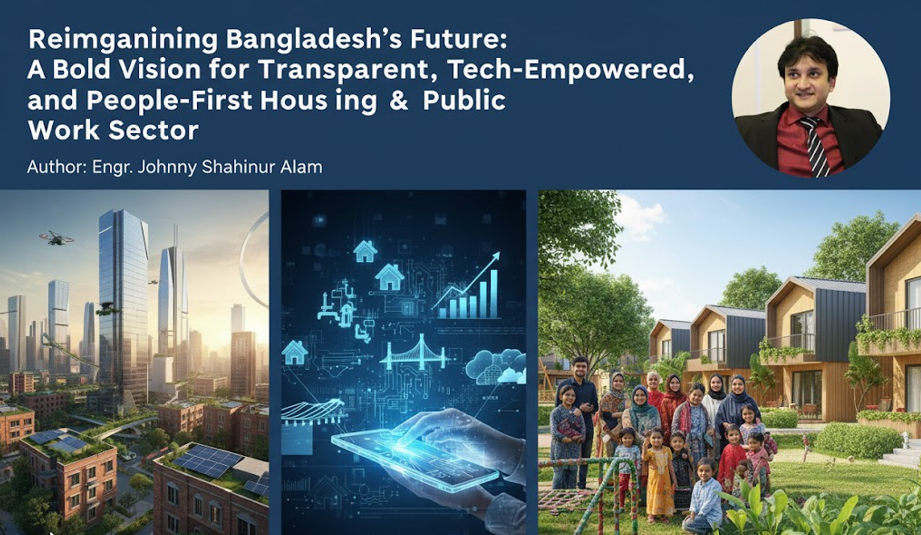
Bangladesh’s Ministry of Housing & Public Works (MoHPW) is central to housing provision, management of public land, and the construction of critical public infrastructure. However, between 2009 and August 2024, the sector has faced persistent and systemic governance failures, entrenched corruption, bureaucratic delays, fragmented data systems, inconsistent construction quality, and insufficient adoption of modern technology.
These Strategic Policy guidelines for 2025–2030 present a research-informed, government-level reform and digital transformation framework. It integrates:
- A comprehensive diagnosis of corruption and governance failures in MoHPW and its key agencies (RAJUK, NHA, PWD, Ministry Secretariat) between 2009 and 2024;
- A policy and governance reform agenda structured around seven strategic pillars;
- A detailed technical solution and system architecture, including GIS, AI, IoT, drones, blockchain and digital twins;
- A phased digital transformation roadmap (2025–2030);
- A coherent governance and regulatory reform package; and
- An implementation, financing and monitoring framework.
INTRODUCTION
Rapid urbanization, demographic pressures, and economic growth have significantly increased demand for serviced land, safe housing, and public infrastructure. Yet systemic corruption, procedural opacity, and administrative inefficiencies have undermined the Ministry’s ability to meet national needs.
Findings from audits, investigations, and judicial reviews demonstrate:
- Misallocation and capture of public land and flats;
- Unsafe and non-compliant buildings due to regulatory failure;
- Procurement irregularities and substantial leakage of public funds;
- Erosion of public trust in the Ministry’s oversight and governance.
This White Paper outlines a time-bound, comprehensive reform programme anchored in governance improvement, digital innovation, capacity development, and sustainable housing reforms.
POLICY RATIONALE AND CONTEXT
The need for reform is driven by:
- Demographic and urbanization pressures in major and secondary cities.
- Escalating demand for affordable and climate-resilient housing;
- Documented governance failures (2009–2024) in allocations, procurement, and regulation.
- Alignment with national goals.
- Availability of 4IR technologies—AI, GIS, drones, IoT, blockchain—to modernize governance.
MoHPW must transition from an analogue, fragmented, compliance-weak system to a digitally integrated, rule-based, and citizen-centric governance model.
SECTOR DIAGNOSTICS: GOVERNANCE, CORRUPTION AND SERVICE DELIVERY FAILURES
Governance & Corruption Failures (2009–2024)
Extensive evidence from special audits, ACC investigations, CAG observations, High Court directives, and independent research reveals deep structural weaknesses in land management, procurement, building approval, and service delivery.
Key systemic findings
- 282 cases of corruption and irregularities identified in NHA audits.
- High Court–mandated review of all RAJUK allocations (2009–2024).
- Tk 26,089 crore in financial discrepancies flagged by CAG.
- Widespread unauthorized payments, plan deviations, and safety non-compliance in RAJUK-regulated buildings.
Representative corruption patterns
- Elite capture: Manipulation of RAJUK records and unlawful acquisition of government plots and flats.
- Bribery and extortion: “Speed money” for land-use clearance, plan approval, and routine services.
- Procurement fraud: Inflated contracts and collusion (e.g., Rooppur Green City misappropriation of ~Tk 36.4 crore).
- Regulatory non-enforcement: Unsafe, non-compliant buildings due to rent-seeking.
- Large-scale financial mismanagement: Persistent unresolved audit objections across agencies.
These issues confirm that corruption has been institutional, long-standing, and multi-level, warranting comprehensive structural reform.
Urban Planning & Land Management Challenges
- Uncontrolled urban sprawl and weak enforcement of zoning regulations.
- Absence of a unified national digital land and cadastral system.
- Overlapping mandates across RAJUK, NHA, PWD, LGED.
- Limited use of GIS and geospatial analytics.
Bureaucratic & Institutional Inefficiencies
- Paper-based permits and slow approvals.
- Fragmented systems and institutional silos.
- Lack of inter-agency data interoperability.
Construction Quality & Infrastructure Failures
- Substandard materials and weak field supervision.
- Lack of structural health audits.
- Frequent delays and cost overruns.
Technological Deficits
- No unified digital governance platform.
- Minimal use of IoT, AI, drones, or digital twins.
- Outdated information systems.
Affordable Housing Crisis
- Significant housing deficits in urban regions.
- Rapid expansion of informal settlements.
- Underperforming public housing schemes.
- Limited climate-resilient housing solutions.
STRATEGIC VISION AND GUIDING PRINCIPLES (2025–2030)
Vision
“To develop an efficient, transparent, inclusive and digitally enabled housing and public works sector that delivers safe, affordable and climate-resilient urban services and infrastructure.”
Guiding Principles
- Rule-Based Governance & Zero Tolerance for Corruption
- Digital-by-Default Service Delivery
- Citizen-Centric and Inclusive Planning
- Data-Driven Decision-Making
- Climate Resilience and Environmental Sustainability
- Institutional Accountability and Performance Orientation
POLICY GOALS AND OUTCOME TARGETS
By 2030, the Government will strive to:
- Reduce corruption incidence in priority processes (procurement, allocation, approvals) by at least 50%;
- Reduce processing times for key approvals (building plans, land use changes, allotments) by 60%;
- Increase the stock of affordable housing (public, PPP and other instruments) by at least 40%;
- Digitize 100% of land, building and zoning records in major metropolitan areas;
- Reduce major construction failures and severe non-compliance incidents by at least 30%;
- Ensure that all major new public buildings comply with green and climate-resilient construction standards.
RESEARCH METHODOLOGY & ANALYTICAL FRAMEWORK
This guideline is built on a rigorous mixed-methods research design that integrates qualitative inquiry, quantitative analysis, and international benchmarking to ensure that all recommendations are evidence-driven, operationally feasible, and aligned with global best practices.
Qualitative methods ,including key informant interviews, focus groups, field observations, regulatory analysis, and corruption-pattern mapping—provide deep insight into institutional behaviours, governance gaps, and operational bottlenecks across MoHPW agencies.
Quantitative analysis of service timelines, audit findings, procurement data, construction performance, digital system logs, and spatial indicators establishes clear baseline metrics and identifies systemic inefficiencies that the reform programme must address.
International benchmarking against Rwanda, Estonia, Singapore, Vietnam, and India highlights proven models for digital land administration, automated approvals, GIS-based planning, blockchain procurement, and drone/IoT monitoring—informing the reform roadmap and technology architecture.
The assessment applies leading analytical frameworks, including the Governance Diagnostic Model, Digital Maturity Index, Land & Housing Value Chain Analysis, Procurement Integrity Assessment, and Smart City Technology Readiness Framework. These tools diagnose corruption entry points, digital readiness, value-chain vulnerabilities, procurement risks, and the feasibility of emerging technologies.
Drawing from extensive primary data (interviews, FGDs, field observations, surveys, operational datasets) and secondary sources (CAG and ACC reports, court directives, master plans, procurement documents, and international case studies), this methodology delivers the most comprehensive diagnostic foundation ever assembled for MoHPW.
Together, these insights ensure that the White Paper’s policy pillars, digital solutions, regulatory reforms, KPIs, budgets, and risk-mitigation strategies are grounded in reality, globally benchmarked, and tailored to Bangladesh’s institutional context—resulting in a coherent, evidence-based reform blueprint for MoHPW’s modernization.
EVIDENCE REVIEW & INTERNATIONAL BENCHMARKING
Global experience demonstrates that digital transformation, integrated governance systems, and advanced spatial technologies dramatically improve land administration, building regulation, procurement integrity, and urban planning. A review of five international frontrunners—Rwanda, Estonia, Singapore, Vietnam, and India—provides actionable insights directly relevant to MoHPW’s 2025–2030 reform agenda.
Rwanda – National Land Information System (NLIS)
Relevance: Digital land registry, GIS mapping, ownership verification.
Rwanda’s NLIS successfully digitized 100% of land parcels, integrating GIS data and national identity systems. Automated processes enable secure transactions, real-time mutation updates, and transparent ownership verification.
Outcomes:
· 80–90% reduction in land disputes
· Significant decline in land office corruption
· Faster mortgage and investment flows
Implication for Bangladesh: A proven model for MoHPW’s National Housing & Land Digital Platform (NHLDP), showing feasibility of nationwide digitization.
Estonia – Digital Identity & e-Governance Interoperability
Relevance: Digital authentication, secure data exchange, interagency integration.
Estonia’s X-Road backbone enables secure, API-based interoperability across all public institutions, underpinned by legally binding digital signatures and a national digital ID.
Outcomes:
· 97% of services fully digital
· Near-elimination of manual manipulation
· High public trust and transparent audit trails
Implication for Bangladesh: A blueprint for NHLDP interoperability, digital signatures, and MoHPW’s “digital-by-default” service delivery model.
Singapore – Urban Digital Twins & Automated Building Plan Checks
Relevance: Smart urban planning, AI compliance checks, BIM-based submissions.
Singapore’s CORENET X system automates building code verification through AI and standardized digital rule libraries, integrated with national digital twins for planning and disaster modelling.
Outcomes:
· ~60% reduction in building approval time
· Higher structural safety and compliance
· Predictive, risk-informed urban planning
Implication for Bangladesh: A strong benchmark for MoHPW’s AI-Based Automated Building Plan Approval System and digital twin–based urban planning.
Vietnam – e-GP Procurement Transparency
Relevance: Curbing corruption in public construction.
Vietnam’s mandatory e-GP, with online tender publication, automated scoring, and financial-audit integration, significantly improved fairness and competition.
Outcomes:
· Reduced price manipulation and collusion
· Higher competition in tenders
· Stronger auditability of public projects
Implication for Bangladesh: Reinforces MoHPW’s urgent need to adopt mandatory e-GP with a blockchain-integrity layer for high-risk projects.
Cross-Country Lessons for Bangladesh
Lesson 1: Digital Land Systems Reduce Disputes
Rwanda and India show 70–90% reductions in disputes after digitization. Bangladesh can replicate this via NHLDP + NID + GIS integration.
Lesson 2: Automated Approvals Reduce Time & Manipulation
Singapore’s experience proves AI-based checks can cut approvals from months to days—directly supporting MoHPW’s reform target of 7–10 day approvals.
Lesson 3: Interoperability Is Essential
Estonia demonstrates that API-based interoperability is critical for transparency, data accuracy, and institutional efficiency.
Lesson 4: Drones & IoT Improve Construction Quality
Countries using drones and IoT report lower fraud, improved safety, and stronger contractor compliance.
Lesson 5: Blockchain Strengthens Procurement Integrity
Immutable procurement records significantly reduce collusion—critical for MoHPW’s high-value infrastructure projects.
Lesson 6: Digital Twins Transform Planning
Singapore shows digital twins enable scenario testing, disaster modelling, and better zoning decisions—highly relevant for Dhaka’s flood-risk and density pressures.
Implications for MoHPW’s 2025–2030 Reform Agenda
The international evidence strongly justifies:
· Immediate nationwide digitization of land and housing records
· Codified digital building codes for AI-driven plan checks
· GIS- and drone-based monitoring for enforcement and quality control
· Interoperable, API-driven governance architecture across RAJUK, NHA, PWD, LGED
· Blockchain-backed procurement systems for integrity and transparency
· Digital twin platforms for predictive, equitable, and climate-resilient urban planning
Collectively, these benchmarks confirm that MoHPW’s reform strategy must be technology-enabled, governance-centred, and evidence-led to meet Bangladesh’s Vision 2041 and Smart Bangladesh ambitions.
POLICY REFORM FRAMEWORK (SEVEN PILLARS)
The reform agenda for the Ministry of Housing & Public Works (MoHPW) is organised around seven mutually reinforcing policy pillars, underpinned by a coherent suite of strategic digital systems.
Seven Strategic Policy Pillars
- Governance, Transparency and Anti-Corruption Introduces mandatory e-GP, blockchain-backed procurement integrity, public dashboards, and stronger audit and whistleblowing mechanisms to address entrenched corruption and opaque decision-making.
- Digital Transformation and Data Integration Establishes a unified National Housing & Land Digital Platform (NHLDP), interoperable databases, and API-based integration between MoHPW, RAJUK, NHA, PWD, LGED, Land Ministry and utilities, creating a single source of truth for land, housing, and project data.
- Urban Planning and Land Management Reform Deploys GIS-based planning systems, updated zoning and land-use controls, satellite and drone-based enforcement, and digital land banking to manage growth, prevent encroachment and support evidence-based urban development.
- Construction Quality and Infrastructure Safety Introduces a National Construction Quality and Standards Authority (NCQSA), third-party audits, IoT-based structural health monitoring, and drone inspection to raise construction standards and reduce structural risk.
- Affordable Housing and Slum Upgrading Scales up PPP-based affordable housing, microfinance-linked housing schemes, digital allotment systems, and targeted slum upgrading programmes focused on services, safety, and tenure security.
- Sustainability, Climate Resilience and Green Housing Embeds green building codes, energy-efficient public buildings, and climate-resilient housing typologies into investment decisions, supported by risk and climate data from GIS and digital twin models.
- Institutional Capacity Building and Change Management Establishes dedicated digital and technical units, invests in skills (GIS, AI, drones, data analytics), and reforms performance management to ensure that organisational capacity matches the ambition of the reform and technology agenda.

Core Technical Solutions & Architecture
The policy pillars are operationalized through an integrated digital architecture comprising six flagship systems:
National Housing & Land Digital Platform (NHLDP) The foundational data backbone that consolidates land records, cadastral data, allotments, permits, occupancy certificates, zoning and project information. Built as a cloud-native, microservices-based system with GIS integration, secure APIs, PKI-based digital signatures, and strong access controls, NHLDP enables real-time verification, transparency, and auditability across all land and housing transactions.

AI-Based Automated Building Plan Approval System A rules- and AI-driven platform that digitizes submissions, performs automated checks on zoning, setbacks, FAR, structural and fire safety, and routes only complex or high-risk cases for human review. It reduces approval time from 4–6 months to 7–10 days, minimizes discretion and rent-seeking, and generates full digital audit trails and performance dashboards.

Drone & IoT Smart Construction Monitoring System Combines routine drone surveys and computer vision–based deviation detection with IoT structural health sensors on critical assets. This system monitors progress, flags unauthorized deviations, detects early signs of structural distress, and feeds data into central dashboards and asset management systems for predictive maintenance and better enforcement

GIS Urban Planning and Land Management System A modern GIS platform with layers for parcels, zoning, infrastructure, risk, and socioeconomic data. It supports plan preparation and revision, scenario analysis, encroachment detection, and public transparency through a controlled GIS viewer. Fully integrated with NHLDP, AI approvals and digital twins, it anchors spatial planning and land governance.
National Digital Twin Infrastructure Dynamic 3D models of priority cities and critical infrastructure nodes, integrating real-time and periodic data. Digital twins are used to simulate floods, traffic, growth patterns, and infrastructure stress, guiding decisions on housing location, zoning reform, retrofits, and resilient public investment planning.

Blockchain Procurement Integrity System A permissioned blockchain layer that records key procurement events—tender publication, bid submissions, evaluations, contract milestones, and payments—ensuring immutability and traceability. Integrated with e-GP, NHLDP and financial systems, it raises the cost of collusion, supports rapid verification by ACC/CAG, and provides strong safeguards for high-risk, high-value projects.

Cross-Cutting Design Principles
All systems are built on common architecture and governance principles:
- Interoperability via standardized APIs and shared identifiers (parcel ID, project ID);
- Security and privacy through encryption, PKI, RBAC, MFA, and national cybersecurity compliance;
- Scalability and resilience using cloud-native, modular designs and robust disaster recovery;
- User-centric design tailored to citizens, developers, planners, inspectors, auditors, and policymakers;
- Open standards and vendor neutrality to avoid lock-in and ensure long-term sustainability.
Together, the seven policy pillars and the integrated digital architecture form a coherent, systemic framework to move MoHPW from fragmented, paper-based governance to a transparent, efficient, and technology-enabled sector by 2030.
DIGITAL TRANSFORMATION ROADMAP (2025–2030)
The digital transformation of MoHPW will follow a three-phase, five-year roadmap that builds foundational systems, scales automation, and transitions to advanced smart-governance capabilities. The roadmap is structured to ensure feasibility, institutional readiness, and measurable governance impact.
Phase 1 (2025–2026): Digital Foundations
Strategic Objective: Establish core digital platforms, data structures, and governance mechanisms.
Key Achievements Targeted:
- NHLDP v1 operational as the national land–housing digital backbone
- Full e-GP adoption across MoHPW
- Initial GIS datasets for Dhaka and a secondary city
- Digital permit pilots launched
- Institutional and capacity foundations established
Priority Actions:
- Deploy National Housing & Land Digital Platform (NHLDP v1) with digitized parcel, allotment, and permit data in priority cities
- Mandate e-GP for all eligible tenders and integrate procurement metadata with project systems
- Launch AI Pre-Check Lite for digital building applications in RAJUK and a second metropolitan authority
- Develop GIS baseline layers (base maps, zoning, parcels)
- Establish the Digital Transformation Directorate (DTD) and train ~500 officials in digital workflows, GIS, and e-GP
Outcome: A unified digital foundation enabling transparency, data integrity, and consistent workflows across MoHPW agencies.
Phase 2 (2027–2028): Expansion & Automation
Strategic Objective: Scale digital systems nationwide and automate high-discretion processes.
Key Achievements Targeted:
- Nationwide rollout of AI-based building approval systems
- NHLDP v2 fully integrated across urban centres
- Drones and IoT sensors deployed for monitoring major works
- Citizen-facing digital services widely adopted
Priority Actions:
- Expand NHLDP to cover all major urban centres; integrate with NID, utilities, and LGD systems
- Roll out AI-Based Automated Building Plan Approval in RAJUK, CDA, KDA, RDA and other city authorities
- Implement mandatory drone-based construction monitoring for large projects
- Deploy IoT structural health sensors on high-risk public assets
- Launch the MoHPW Citizen App/Portal for permits, allotments, verification, and complaints
- Provide large-scale training for AI, GIS, drones, and data-driven supervision
Outcome: Automated, transparent, and efficient service delivery with real-time visibility across the project and construction lifecycle.
Phase 3 (2029–2030): Smart Governance
Strategic Objective: Leverage mature digital systems for predictive, resilient, and paperless governance.
Key Achievements Targeted:
- Digital twins operational for major cities
- Predictive analytics routinely support planning and regulation
- Blockchain procurement layer active for high-risk projects
- MoHPW operating through integrated, paperless, digital workflows
Priority Actions:
- Deploy National Digital Twin Infrastructure for Dhaka, Chattogram, and priority urban centres
- Implement Blockchain Procurement Integrity Layer for high-value projects
- Develop predictive analytics models for housing demand, compliance risk, and asset maintenance
- Launch Smart Slum Upgrading Platform integrating satellite, drone, and socioeconomic data
- Consolidate and optimize all digital systems; retire legacy processes
Outcome: A fully digitized, analytics-driven MoHPW capable of proactive regulation, transparent procurement, smarter planning, and resilient infrastructure management.
Strategic Impact by 2030
- 60% reduction in approval and service delivery times
- 50% reduction in procurement-related corruption risks
- 100% digitized core land, housing, and construction records in major urban areas
- Real-time monitoring of major projects and critical public assets
- Predictive planning using digital twins and analytics
- Fully integrated digital governance across MoHPW and its agencies
Together, these phases form a sequenced, evidence-based transformation pathway, positioning MoHPW as a modern, transparent, and technology-enabled institution.
GOVERNANCE, REGULATORY & INSTITUTIONAL REFORMS
Insert:
- Digital Building Approval Act / Automated Building Approval Act
- National Land Digitization / Digital Land Administration Act
- Public Construction Quality Authority Act (NCQSA)
- Drone Monitoring & Geo-Compliance Regulation
Plus creation of:
- Digital Transformation Directorate
- Inter-Agency Data Integration Council
- Procurement Integrity Taskforce
IMPLEMENTATION ARRANGEMENTS
Successful digital transformation of the housing and public works sector requires a strong enabling environment. The following summarizes the essential legal, regulatory, and institutional reforms, along with the implementation mechanisms necessary to ensure effective and coordinated execution of the 2025–2030 modernization agenda.
Priority Legal and Regulatory Reforms
A modernized legal framework is critical for digitising land administration, automating approvals, improving construction quality, and enabling technology-driven monitoring. Four flagship reforms are proposed:
Digital Building Approval Act
Establishes the legal foundation for automated, AI-assisted building approvals. Provisions:
- Legal recognition of digital submissions, signatures, and approvals
- Mandatory digital processing of building plans
- Codified zoning and building standards for AI engines
- Defined review and appeals mechanisms
- Requirements for auditability, data privacy, and integrity
Digital Land Administration Act
Mandates nationwide digitization and interoperability of land, parcel, and zoning records. Provisions:
- Legal mandate for digital land information systems
- Standardized parcel identifiers
- Integration with NID and Land Ministry databases
- Public access to non-sensitive land and zoning data
- Rules for dispute resolution arising from digital records
National Construction Quality & Standards Authority Act (NCQSA)
Creates an autonomous national body to regulate public construction standards and safety. Provisions:
- Establishment of NCQSA as a dedicated regulator
- Authority to set and enforce material, structural, and fire safety standards
- Contractor/professional certification and sanctions
- Mandatory periodic structural audits of high-risk assets
Drone Monitoring & Geo-Compliance Regulation
Provides the legal framework for drone-based oversight and geospatial enforcement. Provisions:
- Authorization for MoHPW agencies to conduct drone monitoring
- Data protection, privacy, and airspace-use standards
- Legal validity of drone imagery as enforcement evidence
- Mandatory drone surveys for major public works
Institutional Reforms and New Bodies
To operationalize the digital transformation agenda, three new institutional mechanisms will be established:
Digital Transformation Directorate (DTD)
A permanent MoHPW directorate responsible for all digital governance systems. Functions:
- Manage NHLDP, AI approvals, drones/IoT, digital twins
- Develop standards, SOPs, and cybersecurity protocols
- Lead training, capacity-building, and change management
- Coordinate with ICT Division, a2i, and tech vendors
Inter-Agency Data Integration Council (IDIC)
Ensures interoperability and coordinated data governance across relevant agencies. Members: MoHPW, RAJUK, NHA, PWD, LGED, Land Ministry, LGD, ICT Division, Department of Architecture Functions:
- Approve data standards and integration frameworks
- Mandate API use and interoperability protocols
- Resolve cross-agency data-sharing challenges
Procurement Integrity Taskforce
Strengthens governance of high-value, high-risk public procurement. Members: MoHPW, PWD, CPTU, Finance, ACC, independent experts Functions:
- Identify high-risk projects for enhanced scrutiny
- Oversee blockchain integrity tools
- Analyse procurement data for red flags and collusion
- Recommend corrective and systemic reforms
Implementation Arrangements
Effective execution requires clear roles, structured coordination, and strong oversight.
Lead and Implementing Agencies
Lead Ministry: MoHPW – responsible for strategic leadership, policy direction, and overall accountability.
Key Implementing Agencies:
- RAJUK – urban development and approvals in Dhaka
- NHA – public housing and allocation management
- PWD – construction and maintenance of public buildings
- LGED – local infrastructure projects
- Department of Architecture – design and technical vetting
Each agency will establish: ✓ Digital Focal Point ✓ Internal Transformation Cell
Technical Support and Strategic Partnerships
ICT Division & a2i:
- Provide national digital architecture and cybersecurity standards
- Support pilot design, system scaling, and user experience optimization
Universities & Research Institutions:
- Collaborate on AI modelling, GIS analysis, digital twins
- Deliver executive training and joint research
Private Sector Technology Providers:
- Develop, maintain, and upgrade digital systems under strict SLAs
- Participate in PPP arrangements where viable
Oversight and High-Level Coordination
Inter-Ministerial Steering Committee (IMSC) Chaired at a senior political level (Minister/State Minister, MoHPW). Functions:
- Quarterly reviews of digital transformation progress
- Resolve inter-agency bottlenecks
- Approve major system upgrades and investments
Project Management Units (PMUs) Established for major donor-funded digital transformation initiatives, reporting to both MoHPW and IMSC.
BUDGET, FINANCING AND DONOR ALIGNMENT
- Estimated total cost for digital and governance reforms (2025–2030): USD 180–240 million
- Financing sources: GoB budget, development partner projects, climate/urban resilience windows, PPP where applicable.
- Emphasize that anti-corruption and efficiency gains will generate savings and improved value for money over time.
MONITORING, EVALUATION & RESULTS FRAMEWORK
- KPIs: Approval time, procurement transparency, number and value of audit objections, construction quality indicators, digital adoption rates, affordable housing units delivered, slum upgrading targets.
- Tools: Real-time dashboards, quarterly review meetings, annual public reporting, and independent third-party evaluations.
A robust Monitoring, Evaluation and Results (MER) framework is essential to track progress, ensure accountability, and enable adaptive learning.
Objectives of the MER Framework
- Measure progress toward the policy goals and outcome targets set for 2030;
- Detect implementation bottlenecks and course-correct in real time;
- Provide evidence for budget decisions and policy adjustments;
- Demonstrate results to citizens, Parliament and development partners.

RISK ASSESSMENT AND MITIGATION STRATEGIES
- Resistance to change → change management, capacity building, incentives;
- Cybersecurity threats → national cybersecurity standards, secure hosting;
- Funding gaps → multi-donor strategy, phased implementation;
- Data fragmentation → mandatory APIs, interoperability standards;
- Corruption adaptation → blockchain audits, transparency portals, citizen feedback mechanisms.
CONCLUSION
This Strategic Policy Guideline lays the foundation for a fully modernized, transparent and tech-enabled housing and public works sector in Bangladesh, which is linked to a structured, digital and institutional reform programme for 2025–2030. The Government signals a clear shift toward rule-based governance, technological innovation and citizen-centred service delivery.
Successful implementation will require strong political leadership, coordinated institutional reforms, sustained investment in systems and people, and active engagement of citizens and stakeholders. If executed with discipline and integrity, this agenda can significantly reduce corruption, accelerate housing delivery, improve construction quality and build resilient, inclusive urban futures for the people of Bangladesh.
Author:
Engr. Johnny Shahinur Alam Policy Innovator | Digital Governance Specialist | Advocate of Ethical AI and Human-Centred Security Transformation














Leave a comment