
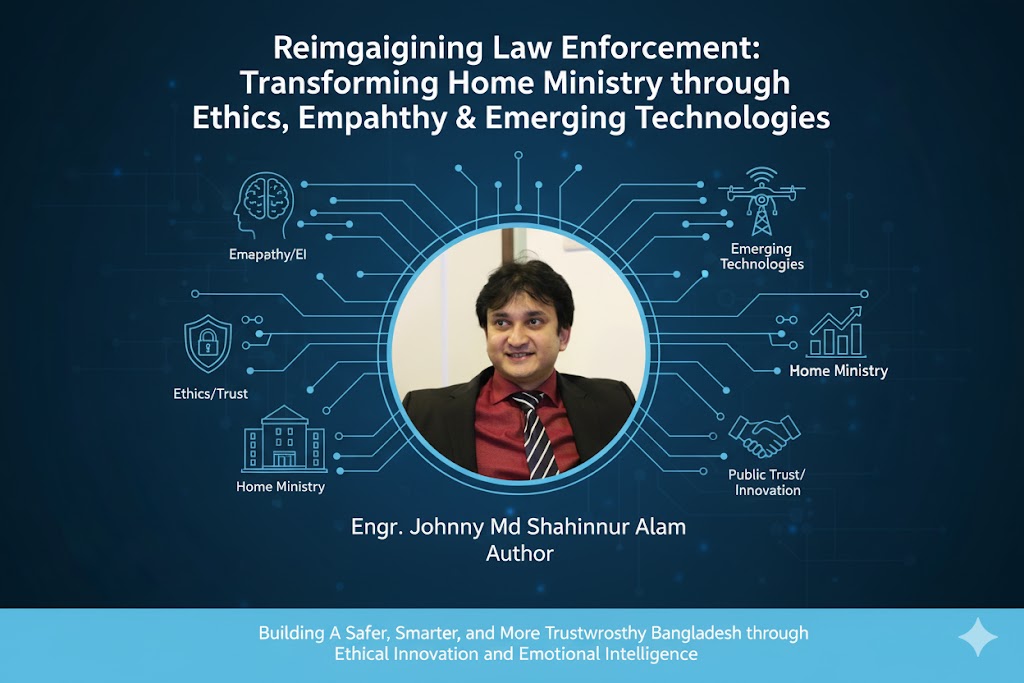
Technology, Leadership and Emotional Intelligence–Driven, Human-Centric Law and Order Transformation. Building a Safer, Smarter, and More Trustworthy Bangladesh through Ethical Innovation and Emotional Intelligence.
Executive Summary
Bangladesh is entering a decisive decade for internal security and governance. While the country has advanced in digitisation, counter-terrorism, and growth, public trust in law enforcement remains fragile. Surveys by Transparency International Bangladesh (TIB, 2024) and the BRAC Institute of Governance and Development (BIGD, 2023) show that police are perceived as one of the least-trusted institutions, associated with corruption, political interference, and heavy-handed tactics.
At the same time, the nature of threats is evolving: organised crime, communal violence, cyberattacks, online radicalisation, disinformation, and transnational crime. Traditional, reactive policing is no longer sufficient.
This article proposes a comprehensive, integrated framework (2025–2035) that combines:
- Technology-enabled law and order management (2025–2030), and
- National police transformation and public trust reform (2025–2035).
It rests on three core pillars of change:
- Digital and Operational Transformation – AI-driven predictive policing, smart surveillance, data integration, digital forensics, cyber defence.
- Human and Cultural Transformation – emotional intelligence (EI/EQ), welfare, motivation, integrity, and transformative leadership.
- Governance, Ethics, and Public Trust – transparency, oversight, accountability, and community partnership.
The framework lays out:
- A Vision & Mission,
- Strategic Objectives,
- Ten Policy Pillars,
- A phased implementation roadmap,
- Institutional governance arrangements,
- Global benchmarks and use cases, and
- A full monitoring & evaluation (M&E) framework.
If implemented with political commitment and adequate resources, this framework will help Bangladesh build a trusted, transparent, emotionally intelligent, and technologically advanced policing and internal security system.
1. Vision
To build a safe, just, and digitally empowered Bangladesh where law enforcement agencies are trusted by citizens and maintain peace, security, and justice through ethical, emotionally intelligent, and technology-driven governance, fully aligned with constitutional rights and international human rights obligations.
2. Mission
To modernise Bangladesh’s law-and-order and policing system by integrating:
- Artificial Intelligence (AI), Machine Learning (ML), Deep Learning, Big Data, Smart CCTV, Drones, Cloud Computing, Blockchain, Digital Public Infrastructure (DPI), National e-Service Bus (NeSB), Quantum-resilient Cybersecurity, and
- Emotional Intelligence (EI/EQ), transformative leadership, integrity systems, and community partnership
so that the state can:
- Predict, prevent, and respond to crime and disorder effectively.
- Enhance transparency, accountability, and human rights compliance.
- Strengthen inter-agency coordination and digital evidence-based justice.
- Increase public trust and citizen participation in security governance.
- Empower and protect every police officer as a professional, ethical public servant.
3. Strategic Objectives


4. Guiding Principles
- Rule of Law & Human Rights – All technologies and tactics must respect due process, equality, and dignity.
- Accountability & Transparency – Every data access, AI decision, or surveillance action must be logged and reviewable.
- Human-in-the-Loop – Critical operational decisions remain under trained human authority; AI is advisory, not sovereign.
- Interoperability – Systems must communicate securely via NeSB and DPI across ministries and agencies.
- Data Sovereignty – Citizen data must remain under national control within secure Bangladesh-based or sovereign cloud infrastructure.
- Ethical AI Governance – AI adoption must follow clear frameworks, fairness audits, and independent oversight (Europol, 2024; OECD, 2023).
- Community Partnership – Citizens are co-producers of safety, not merely recipients of state action.
- Whole-of-Government & Whole-of-Society Approach – Home Affairs, ICT, Justice, local government, civil society, and private sector work together.
5. Diagnostic: Challenges in Law & Order and Policing


These challenges undermine both operational effectiveness and legitimacy, reinforcing a vicious cycle: low trust → less cooperation → higher crime → more coercion → even lower trust (Bayley & Shearing, 2021).
6. Integrated Policy & Strategy Framework
To address these challenges, the framework is organised into ten pillars, grouped under three dimensions:
- A. Digital & Operational Transformation (Pillars 1–4)
- B. Public Trust, Integrity & Culture (Pillars 5–7)
- C. Leadership, EI/EQ & Capacity (Pillars 8–10)
A. Digital & Operational Transformation
Pillar 1: Predictive & Preventive Policing
Goal: Transform policing from reactive, incident-driven enforcement to predictive, prevention-oriented security using AI and analytics.
Key Strategic Actions
- National Crime Intelligence & Analytics Platform (NCIAP)
- Smart Surveillance Network
- Sentiment & Social-Media Analytics Unit
- Data Integration via NeSB and DPI
Global Evidence: Predictive policing projects in the USA and elsewhere have achieved local reductions in crime (25–40%) but raised concerns about bias and fairness if not properly designed (CIGI, 2020; Furze, 2021). This underscores the need for bias audits and community oversight (Computer Weekly, 2023).
Pillar 2: Responsive and Coordinated Law Enforcement
Goal: Establish a unified command structure for faster, proportionate, and evidence-based responses.
Key Strategic Actions
- National and Divisional Command & Control Centres (C3)
- Body-Worn Cameras and Smart Evidence Vault
- AI-assisted Crowd & Crisis Management
- Real-Time Incident Analytics & Auto-Reporting
Pillar 3: Modern Investigation, Forensics, and Justice
Goal: Strengthen investigations and prosecutions using digital tools and robust evidence management.
Key Strategic Actions
- National Criminal Identity & Behaviour Database (NCIBD)
- AI Forensics & Deep-Learning Evidence Tools
- Blockchain Chain-of-Custody
- AI-Driven Prosecution Support
Pillar 4: Cybersecurity and Digital Crime Control
Goal: Strengthen cyber resilience, protect critical infrastructure, and counter online harms.
Key Strategic Actions
- National Cyber Fusion Centre (NCFC)
- Digital Identity, e-KYC, and Data Integrity Framework
- AI-Powered Fact-Checking and Counter-Disinformation Unit
Global Use Case: Contactless AI cameras in Bengaluru detect ~87% of traffic violations, increasing enforcement efficiency (Times of India, 2024; Supercharge, 2023). Similar approaches could help Bangladesh manage traffic offences and road safety.
B. Public Trust, Integrity & Culture
Pillar 5: Public Trust and Community Partnership
Goal: Transform citizen–police relations from fear-based to trust-based.
Key Strategic Actions
- Community Policing 2.0 – Digitally enabled community policing with mobile apps and web portals for co-reporting issues, volunteerism, and feedback.
- Local Safety Forums – Jointly chaired by community leaders and police at thana and ward levels.
- Public Police Dashboard – Online display of response times, complaint outcomes, integrity indicators, and service standards.
- Blockchain-based Complaint Tracking – Every complaint registered, time-stamped, and traceable until resolution.
Global Benchmark: Japan’s Kōban model (neighbourhood police posts) builds everyday, informal trust and significantly supports crime prevention (Bayley, 2019).
Pillar 6: Integrity, Anti-Corruption and Morality
Goal: Embed ethical conduct and systematically reduce corruption.
Key Strategic Actions
- AI-driven Integrity Scorecards – Aggregate citizen feedback, complaint patterns, and peer reviews to flag risks and reward integrity.
- Independent Police Integrity Commission (IPIC) – Autonomous authority to investigate misconduct, drawing on digital evidence logs.
- Blockchain Evidence & HR Logs – Use blockchain to secure evidence, transfers, and promotion histories.
- Ethics Circles & Values Workshops – Regular small-group sessions where officers reflect on dilemmas, guided by trained facilitators and ethicists.
Global Benchmark: Singapore Police incorporate integrity criteria into performance and promotion systems, contributing to a reputation for clean policing (Lee, 2020).
Pillar 7: Transparency, Oversight, and Public Accountability
Goal: Make policing processes visible and explainable to citizens.
Key Strategic Actions
- Public Transparency Dashboard – Redacted operation summaries and statistics published within 24 hours for significant incidents.
- Independent Oversight Board (IOB) – Judges, civil society, technologists, and human-rights experts regularly review police and AI system performance.
- Quarterly Transparency Reports – Public reports on complaints, AI usage, and disciplinary outcomes.
C. Leadership, EI/EQ & Capacity
Pillar 8: Empowerment, Motivation and Welfare
Goal: Create a proud, protected, and purpose-driven police service.
Key Strategic Actions
- Comprehensive Police Welfare Framework – Health insurance, psychological care, housing, children’s education, and pension reform.
- Merit and Integrity Recognition Programme – Awards and career benefits for officers demonstrating empathy, integrity, and professionalism.
- AI-based HR Analytics – Fair, data-informed transfer and promotion system, reducing political manipulation.
- Police Leadership Institute – Continuous professional training in ethics, EI, and strategic management.
Pillar 9: Emotional Intelligence (EI/EQ) and Psychological Resilience
Goal: Equip officers to understand and manage emotions, de-escalate conflict, and cope with stress.
Key Strategic Actions
- EI Curriculum in Police Training – Self-awareness, self-regulation, empathy, communication, conflict resolution (Goleman, 1998).
- VR/AR Simulation Labs – Scenario-based training for domestic violence calls, protests, communal tensions, and crisis negotiation.
- AI-Assisted Counselling & Wellness – Confidential chatbots and referral systems for mental health support and burnout prevention.
- Empathy & Service Awards – Recognise officers who resolve cases through dialogue and compassion rather than force.
Pillar 10: Transformative Leadership and Organisational Renewal
Goal: Shift from hierarchical, fear-based management to transformative, service-oriented leadership.
Key Strategic Actions
- Transformational Leadership Training – Based on Bass & Riggio’s framework of idealised influence, inspirational motivation, intellectual stimulation, and individualised consideration (Bass & Riggio, 2006).
- 360-Degree Feedback – Performance appraisal incorporating feedback from superiors, peers, and community representatives.
- Leadership Mentorship Network – Senior officers mentor emerging leaders on integrity, EI, and innovation.
- Station-Level Purpose Statements – Each thana defines measurable social goals (e.g. “Zero gender-based killings by 2030”).
7. Global Reference Use Cases & LessonsThese examples show that technology can dramatically improve detection, prevention, and efficiency, but without strong ethics, oversight, and community engagement, it can deepen inequality and mistrust.


These examples show that technology can dramatically improve detection, prevention, and efficiency, but without strong ethics, oversight, and community engagement, it can deepen inequality and mistrust.
8. Implementation Roadmap


9. Governance and Oversight
- National Steering Committee (NSC): Chaired by the Hon. Minister of Home Affairs; provides strategic direction.
- Digital Transformation Task Force (DTTF): Secretary (Security Services Division), IGP, DGs of RAB/BGB/Prisons, ICT Division, BTRC, Attorney General’s Office.
- Home Ministry Digital Transformation Secretariat (HMDTS): Day-to-day coordination of all digital and reform projects.
- Independent Police Integrity Commission (IPIC): Investigates misconduct and monitors integrity, reporting to Parliament.
- Independent Oversight Board (IOB): Judges, civil society, academia, technologists, human-rights experts review AI, data governance, and major operations.
10. Monitoring, Evaluation & Key Performance Indicators (KPIs)
Regular annual review reports should be submitted to Cabinet, Parliament, and made public.


11. Resource Mobilisation
- National Budget Allocation: Dedicated “Home Ministry Digital Transformation & Police Reform Fund.”
- Development Partners: World Bank, ADB, UNDP, JICA, EU and others for technical assistance and financing.
- Public–Private Partnerships (PPPs): Carefully regulated pilots with vetted tech providers under strict data governance.
- Academic & Research Partnerships: Local universities and think tanks for EI, ethics, AI fairness, and evaluation research.
12. Risk Management and Ethical Safeguards

13. Expected Impacts by 2035
If implemented as designed, the framework will lead to:
- Institutional integrity embedded in police culture.
- Significant rise in citizen confidence and cooperation.
- Lower rates of violent and organised crime through predictive prevention.
- Substantial reduction in extrajudicial practices as formal systems become effective and trusted.
- A digitally connected, emotionally intelligent, and ethically grounded police service that is seen as a partner, not a threat.
14. Conclusion
The future of law enforcement in Bangladesh will not be defined by the number of weapons or vehicles, but by the depth of trust and integrity between citizens and the state.
This article proposes a National Police Transformation & Public Trust Framework, anchored in:
- Technology that predicts, prevents, and documents fairly;
- Leadership that inspires, protects, and serves;
- Emotional Intelligence that humanises policing; and
- Governance that is transparent, rights-respecting, and accountable.
Rebuilding trust and integrity is not a one-off project. It is a long-term cultural transformation. With strong political will, robust institutions, and engaged citizens, Bangladesh can build a policing and internal security system that genuinely serves its people and strengthens democracy.
Author:
Engr. Johnny Shahinur Alam Policy Innovator | Digital Governance Specialist | Advocate of Ethical AI and Human-Centred Security Transformation














Leave a comment